(Almost) Ending the Year On Some Trendy Business

We know, we know…it’s not our last post of the year, but it’s close to it! We figured it would be good for anyone looking into getting published to get the heads up: the results are in, publishing trends are here.

Before we get started though, we want to direct you to the source in which the general info comes from. Opinions and advice are ours! But check out this blog/publishing service.

Let’s get right into it!

going up.gif

  1. First and foremost, is the decline in reading going to push writers away from publishing their work?

    We vote a big fat NO. Reason being, we see the decline in reading as a way to push writers to treat their work with care (and to get into e-Pubbing, but we’ll discuss in a second.) Getting all the pre-publication shenanigans out of the way is something so many people don’t truly pay attention to – so maybe, it’s time we give our precious work some TLC and hire a few people to take a look at what we’ve got.

  2. Print books remain #1. What does this mean for you?

    While everyone (or maybe it was just me) believes that eBooks are the only way to read now, we come here to confirm: this is not true. Print books remain the champion of reading (even if less people do the act of reading.) Now, before you comment and say, “getting my book printed will cost so much money” or “I can’t seal the deal with PRH or Tor or any of those big publishers!” Don’t forget about print-on-demand: the most efficient way for a self-published author to get their book in physical format! So you can still make your way into the print market without a major publishing deal (sorry, big guys.)

  3. Audiobooks are still on the rise!

    We love audiobooks here at HRM. We talk about them enough to say we’re not surprised they’ll continue to rise come the new year.
  4. We’ve talked about it once, we’ll talk about it again: hybrid/collaborative publishing is important and will continue to rise in popularity in 2019. Why should it be important to you?

    Hybrid publishing and collaborative publishing are important mediums to self-published authors (or writers looking into self-publishing.) We want the quality of a major publisher (you know, the big tough editors and the fantastic printing jobs) but since deals from them are far and few between, we need an alternative. An alternative where we have creative flexibility and control over the work in question. These mediums are just that. They provide the quality care to your work as well as giving you the power over it – with consideration, of course. Major publishing houses ensure a bigger paycheck, but why not get your foot in the door to start?

  5. Marketing is your best friend.

    We talk about marketing a lot on this blog. It’s an important part of being a writer/author who wants exposure. If you’re interested in keeping up with a variety of marketing tactics, just use the search bar for this blog and we guarantee you’ll come across something.


Happy Holidays, everybody!

A Blob

Nuppeppo.jpg

Nuppeppō Japan

“Passive, genderless blob one can eat to gain eternal youth.”

Basic Facts:

  • This yōkai has a pungent body odor because it’s supposedly made up of corpses. I knew there was a catch…Makes it that much harder to eat.
  • While other spirits have some form of origin tale…the nuppeppō doesn’t. Even though it’s been around since the 18th century.
  • You’ll most likely find this blob in deserted streets, abandoned temples, and…you guessed it…graveyards.
  • They are entirely harmless!
  • Although the blob is just that…a blob…the nuppeppō has folds all over it. Which makes it look like it has eyes, a nose, a mouth, arms and legs.

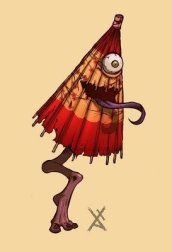
All Umbrellas Mean Bad Luck

kasaobake.jpg

Kasa-obake | Japan

“Animated umbrellas that jump around on one leg.”

Basic Facts:

  • Here we have another yōkai (like the ittan-momen and bake-kujira.) This can sometimes be thrown under the same name as the ittan-momen: a tsukumogami, but not all consider it to be that.
  • Other names include: karakasa-obake, kase-bake, and karakasa kozō.
  • If you couldn’t tell by the art above, the kasa-obake have a very distinct appearance. It’s usually an umbrella with one eye, hopping around on one leg. In some rare cases, they’ll have two legs but it’s highly unlikely to find. Every once in awhile, it’ll have two arms and sometimes be described to have a long tongue.
  • Initially, the kasa-obake was simply a humanoid spirit with an umbrella on its head…but as time went on the human became an umbrella. This is why people believe it to be a tsukumogami.
  • This is the most well-known yōkai (that is an object) and has been incorprated into card games, haunted houses, anime (Japanese animated shows), manga (Japanese comic books/graphic novels), and movies.

Swimming With Revenge

bake kujira.jpg

Bake – KujiraJapan

“Ghost whale that is accompanied by bizarre birds and unknown fish.”

Basic Facts:

  • Another name for the bakekujira is honekujira, which translates to “bone whale.” They pretty much are undead whales who are followed by weird looking birds and funky fish.
  • They can be found in the sea of Japan. The people will see the ghost whale on rainy nights, off the coast…of whaling villages. See where we’re going here?
  • What powers can this haunting whale possibly have? Legend has it, when you see the whale, you’re cursed. Usually what happens is, someone will become cursed, return to their village and the village will suffer at the hand of the curse. Plague, famine, fires…any disaster you can imagine. Prepare.
  • Do you remember the yōkai from our last post? The bakekujira is one, too.
  • There are some explanations as to why the legend came in to existence about this whale. Someone has said it could have been an enemy village, creating a fake whale to haunt the fisherman out at sea. There is another idea about a whale carcass carrying disease to a village and not a ghost whale.

The Least Expected Myth

This week’s mythological monster is a day late but well worth it! This week’s highlight was one for the books and a new one even I hadn’t heard of.

Keep reading if you want to hear about a bolt of cotton that will smother you to death if given the chance.


ittan momen.jpg

Ittan-momenJapan

“Sentient roll of cotton that flies through the night and suffocates people.”

Basic Facts:

  • In Japanese mythology, the ittan-momen is a Yōkai, more specifically a Tsukumogami. A yōkai is a supernatural spirit in folklore while a tsukumogami is a tool that has been possessed by a supernatural spirit. Haunted items…spooooooky.
  • These spirits are more likely to be found in Kagoshima.
  • The type off cotton possessed is also what can be used to make clothes. Check your labels!
  • “Ittan-momen” literally translates to “one bolt of cotton” or “one tan of cotton.” It gives the idea of what the measurements are of the item (28.8 cm by 10 m).
  • Believe it or not…the ittan-momen has been adapted plenty in Japanese modern culture. Shows (anime, primarily) and monuments have been made in appreciation.

Foxy Lady

gumiho.png

Gumiho Korea

“Nine-tailed fox that freely transforms into a beguiling woman.”

Basic Facts:

  • How does the fox become the woman? It lives a thousand years.
  • The goal of the gumiho (also called Kumiho in Korea) is to seduce boys and lure them off to eat their organs. They focus on primary organs, such as the liver and heart.
  • Since the legend of the gumiho originated in China and also has a sister legend in Japan, the gumiho is differentiated by the item it carries. The gumiho keeps a marble of knowledge but it’s also used to help drain human energy. If a human steals the marble…they gain knowledge!
  • Even though they can turn into a woman, they maintain fox-like features.
  • Hoping for some good news? If the gumiho doesn’t kill or eat any humans…they’ll become human. Don’t forget…they’re spirits, not actual animals.

A Visual Tale

Originating in Japan, the visual novel has made quite the impact on interactive reading for tweens, teenagers, and new adults.

A platform designed for artists and storytellers, visual novels take reading to a new level. Some stories revolve around custom characters, while others don’t. The storylines vary but the biggest genre here is romance.

By teaming up with graphic designers or digital artists, authors can create a version of their story which would appeal to those who like visuals accompanying their story or travel down the similar route as Harry Potter. (We’re talking about the game released where you become the witch or wizard, in case you missed it!) Building the world for your readers first and building a fanbase, may make transitioning to visual novels much easier. They don’t all have to be romance stories; they’re just the easiest genre to get into!

visual novel.gif

Nine Imps

dokkaebi.jpg

Dokkaebi Korea

“Impish spirits that transform from inanimate objects.”

Basic Facts:

  • Also called Korean goblins, they like to play tricks on humans (or help them – it can go either way.)
  • Physical descriptions of the dokkaebi can be found on ancient roof tiles but are usually frightening to look at.
  • Into wrestling? So are these spirits! in order to pass them, you should be able to wrestle your way out of their clutches of evil! Their weak spots include their right side and (some of them are one-legged) a simple push will get them down.
  • There are different types of dokkaebi. To be frank, there are nine common types.
  • Sometimes, rituals are hosted to get in the good graces of the dokkaebi but other times.

Be Rewarded

pixiu.jpg

Pixiu China

“Winged lion that words off spirits and attracts wealth”

Basic Facts:

  • The Pixiu is a protector of those who practice Feng Shui.
  • A creature well associated with wealth; it is also associated with Earth and Sea elements.
  • There are male and female variations of the Pixiu. They’re referred to as Bìxié (male) and Tiān lù (female). The Bìxié is known to be in charge of the wealth, while the Tiān lù shoos off bad spirits.
  • In terms of the wealth they bring in, they are picky. The prefer gold, silver, and jewelry.
  • As years have gone by, the Pixiu has maintained their love for wealth. Statues are often used in the practice of Feng Shui and the philosophy is: wealth will come. They’re also used in Jade pendants in modern jewelry.

Overlapping Myths and Traditions

This is the first of our mythological creatures from East Asia and can we just say: we are so excited to share these!

For this week, we’re looking at the traditional Chinese dragon, also known as the East Asian Dragon. This creature is widely known within and beyond Asian history, used as symbols of great strength and honor. But let’s jump right in and see what we could possibly teach you!


chinese dragon.jpg

Chinese DragonChina

“Long, serpentine creature with elemental powers.”

Basic Facts:

  • Don’t be fooled! The serpent-like animal is the more commonly known dragons. They’re also described as turtles and fish.
  • The dragon usually has powers to control water, rainfall, typhoons, and floods (do you see the common trait of strength behind this all?)
  • Scholar Wang Fu of the Han dynasty recorded myths about long dragons having distinct features. It’s an interesting Google search!
  • Depictions of the East Asian dragon sometimes feature a flaming pearl. It’s symbolic of spiritual energy, wisdom, prosperity, power, immortality, thunder, or the moon.
  • Wings? Nope! East Asian dragons fly with the help of their mystical powers, nothing physical helps them soar through the sky.