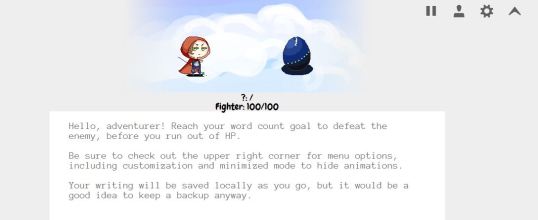
We are big advocates for demolishing writer’s block. We’ve talked about a variety of methods, websites, and apps to use against a writer’s worst nightmare. Here is a new one for you: Fighter’s Block.
So, after playing around with the online app for a few levels, I can officially declare this as a fun way to defeat writer’s block. There’s only a select amount of characters you can choose from and there’s only one enemy unlocked but there are little details in the structure and immersion of the game which makes it worthwhile.
Let’s break it down!
Cute pixel sprites go up against each other in a game that challenges you to write, write, write before your character’s health reaches zero. You start off by choosing your hero (you can choose between Red or Karen, Quin is locked until you reach level 11) and your word goal for that particular level. Once you click fight, the battle has begun.
You’ll notice the health bar of your character slowly (or quickly) diminishing if you’re not typing. As you write, the character’s health is regenerated and the enemy’s lowers.
To add more flair to your experience, you can customize your fighting background and writing difficulty to challenge yourself. The theme can be changed to different color schemes that can better your playing/writing experience. With the opponent you can easily change its speed and attack which works against you as you’re writing.
Your writing space can also be customized. From font to the display of your text box, this game is perfect for any writer looking for new ways to get back into the swing of things.
Many issues have risen about the casting in Hollywood. From casting directors putting actors and actresses in roles racially not suited for them to the huge age gaps in some of the leading romances. Well, we’ve come here to say, not all book-to-film adaptations have to be horrible.
We always have to remember what goes on behind the scenes (i.e. contracts between agents and production companies). What we do know is a couple of films have released recently where casting was great and changes were obviously made to make the film adaptation to fit the two hour mark and not six hours and thirty-two minutes. We have yet to see Crazy Rich Asians (which has dominated the rom-com category opening weekend) but in the meantime, let’s discuss the other East-meets-West, Netflix production: To All The Boys I’ve Loved Beforeby Jenny Han.
Now, you’ll never find an adaptation that will include every detail of the book’s original content. And of course, this novel-based film won’t be excluded from that category. One of the biggest issues in casting that has been obvious for many years (yeah, we aren’t talking just in the last decade, we’re talking since the Golden Age of Hollywood) has been casting the wrong race. Authors, if you’re trying to sell the film rights to your book (as a literary agency, we know how it can be), we know you want the best of the best for your book baby. Don’t forget to bring up your stipulations with your agent. Draw the line with production because if they can’t properly cast YOUR characters, they don’t need your idea on their list of things ‘to-do.’ We know; we want our authors’ work to be best represented by whoever chooses to publish the work.
Shout out to Jenny Han for standing up for her main character being cast as an Asian-American actress and staying true to the main plot of the story. 👍
Inspired by a post found on Pinterest, we’re talking about the good and bad behind utilizing flashbacks in your writing. There’s an art behind it, and always a purpose.
Use a flashback to propel the story. Giving backstory to the plot or character can really help your reader understand and comprehend why the plot is unfolding the way it is or why the character’s personality is molded into the current personality (always in correspondence with the plot.)
Don’t spend too long in the flashback. If you’re wandering around and talking about unnecessary details then you’re spending a whole chapter wasting your reader’s time.
Does the flashback serve the “current” time any justice? If it does, keep it. Like we’ve discussed – use it in conjunction to the story line of your story’s present. The flashback could lose its meaning.
Flashbacks are great for any genre…but our personal favorite is the one that gives you the chills. Adding suspense, chilling clues, a haunting past…makes for a helluva scary tale.
Everyone has their memes to get them through the day. We have so many personal favorites to spice up our posts, we thought it was about time we shared some with you all. Plus, it’s nice to sit back and laugh at the accomplishments (or lack thereof) when it comes to working on our writing. Let the memes begin!
First of all, we are starting with the meme everyone can relate to: I have an idea, but haven’t started it yet. Mainly because it’s a tough one to go home after a full day’s worth of work, and put your eyes on a screen if that’s all you’ve done for the work day. Fear not, Lisa Simpson understands your feelings more than you probably know.
Next up, we’ve got a meme for our writers who like the darker side of things. Jim Halpert always mirrors our emotions even at the strangest of times. Writing about things you wouldn’t usually write about (i.e. murder) could be quite alarming for those who don’t know you as a person…or even for those who do know you.
It’s happened to every writer in the history of writing: making characters suffer and enjoying every second of it. Don’t feel bad about this. J.K. Rowling probably made the same face when she was killing off characters in Harry Potter. It’s every writers’ guilty pleasure.
We know what you’re thinking…another meme about killing off characters?! Well, yeah. It’s a guilty pleasure. Plus, nothing is better than building something beautiful then tearing it apart to make another character stronger after they’ve been broken. There’s reason behind the madness…I swear!
Then after everything has been said and done: here comes the editing. Sure, you wrote it now…but who made it sound so awful? Definitely not you! Someone must have written it while you were sleeping or something. All in all, editing isn’t fun. And this face is very relevant.
But this is the most important one. Because why are you reading this post when you should be writing? 😛
Instead of being a creature of malice, this week we are diving into a human-turned-keeper. Keep reading to find out some interesting facts!
Herne the Hunter | England
“The antlered spirit of a hanged man that guards Windsor Forest.”
Basic Facts:
Truth be told…Herne was probably based off of a real keeper of the forest.
Story goes: the hunter made a pact with the Devil, forcing him to be doomed to hunt forever.
He rides at night, mostly but is found during storms.
Herne is said to wear horns, rattle chains, blast trees and cattle BUT…is not commonly seen by mortals.
Our beloved hunter had an oak tree, which is rumored to be where he haunted most of the time, was torn down…but Queen Victoria came to the rescue and replaced it with another oak.
Why is it important to format your book? If you’re new to the industry, maybe it’s time we revisit our publishing journey series we started awhile back.
If you’re sending your manuscript on its journey for representation, double check your submission. The basics?
Font
Margins
Space
Align
Page numbering
Page headers
Chapters
Italics
Single character space
Some extras people tend to forget?
Scene breaks: you have to indicate them withsomething.
Make the ending clear: use THE END or the#sign. Make it clear it’s over.
Don’t forget your title page with all of your information along with your agent’s information as well.
You can make your manuscript look as crazy as possible for your own pleasure but, for goodness sake, don’t send out your blue background and yellow letters make it into an agent’s lap.
It’s always fun to do research, especially when writing. So, this Monday, we wanted to do some basic research for you on one of our favorite subjects in the fantasy-world: magic & magic-users.
Since there are so many different classes of magic, we decided to look at titles some of your characters might hold in your story.
Wizard: source of magic comes from books, learning, and practices.
Warlock:name translates loosely to “truce-breaker” and supposedly gets their power from a higher power (usually seen as an ‘evil’ entity.)
Sorcerer:power comes from within; “sors” Latin for “oracular response.”
Magician:in the paranormal or fantasy sense, magic is used for ceremonial purposes.
Witch:the female “wizard,” essentially.
Mage: magic-user but of an academic source.
Conjuror:magic used in the creation of objects.
Enchanter:magic is used to enhance items or charm people.
It’s important to find your muse and stick with it. Keeping the other creative stories at bay could be hard but worth shutting up until your current piece is complete. But what happens if your muse just so happens to be the news.
You know what I mean: writing a fictional story around a political mishap, or some celebrity scandal or even a cool invention that made its debut on the morning news but triggered your creative gears and now you can’t stop piecing together how it came to be.
Let’s talk about why it might be down your alley to talk about the trends in our society.
People read the news and are consumed by it. Good, bad, whatever it may be. This is what people will always turn to. If you’re in the writing gig and have a general interest in recreating the last scandal that popped up on your phone or TV, we say do it.
Some of the most recent best-sellers included work about politics, magical realism, plain ol’ literary realism/naturalism…but not a nonfiction story.
No, stay away from that unless you’re in a situation where you like the research your conducting.
To put it into perspective, when the Royal Wedding came around…twice…there was a huge influx in sales for stories about princesses and fictional retellings of how the couples came to be.
Think about that the next time you’re tuned into the six o’clock news.
Every adventure tale needs a character to complement the main. It’s the best way to highlight the qualities of the other character (mainly the protagonist.)
Don’t mix this up with juxtaposing. We see that more of comparing or contrasting any two things. Today, we’re focusing on the art of foiling.
If you have a main character who is your pride and joy, one you have taken under your wing and have promised to protect at all costs, then you probably want your readers to think the same thing, no? Create a foil. A foil is meant to be a character who completes the main character, if used correctly. The foil could be that of the ‘ideal’ character, one who has great qualities your MC lacks. If this happens, you may want the foil to get kicked out for some reason, or killed off; everyone loves a good tragic death!
Your MC may need a foil to help further or thicken the plot. So, draft one up and see the endless possibilities of plots and subplots you could have! It could even help develop your MC’s character development.
Pick any door that has opened up! We promise it may help make your character even more lovable!
Writing is already tough as it is, but the thought of character development or simple character creation makes it all the more harder. What happens if you, the writer, want to create and develop a main character who is of the opposite sex or gender?
As humans raised in a society where the social construct revolves around binary gender identification (so, male or female), we tend to think we have the other side figured out. Writing the opposite gender can bump the difficulty of your novel-writing up to 100. Personally, I applaud trans or androgynous characters because although I said our society currently revolves around binary gender IDing, the world is slowly changing and becoming more accepting of such. Why do we have to choose to be one gender, Social Construct? HUH?
Instead of going on about gender identity for a whole blog post, I’m here to try and help you writers out there understand the gender identity of your characters and how to portray them properly without offending anyone. I’m only focusing on men writing female characters and women writing male characters today!
Dudes writing dudettes?Always remember, if diving into the female POV, make sure she has a personality. Girls are people, too. People who have personalities as well experiences which shape them into who they are.
Beyond her INSANElyaverage looks is a deeply complex and developed being, she’s starts to become a person. Not that cardboard cut-out character who is tasteless and has no real meaning to the story.
A few key points about writing a girl:
Girls are empathetic, which is what heightens their emotions.
A girl usually wants to know that someone cares for her, which is why she wants to hang out with her SO all of the time or it seems like she’s always with her friends.
Looking into things is a girl’s MO. Girls do ask each other what they should wear to go out on a date, or what to say to someone.
For a bit more detail into those things I mentioned and a bit more, see this blog. The author of this blog really describes the nitty gritty details of the points she finds most noticeable in a female character, particularly in their POV.
Moving on!Dudettes who are writing their hunk of burning love…remember, he’s not real. He can’t be Mr. Perfect. If dudes can’t write women up to be super warriors with gigantic breasts and long legs, there should be no reason to write up a six pack with bulging muscles. Not every guy is tall, dark, and handsome.
Name that movie!
Following the same rule earlier, give this guy his own unique personality. After that, you can add some good looking qualities, then the flaws. Make sure the guy is as realistic as possible because if you’re trying to reel in male readers…you’re not going to get it by stabbing his ego (just like a guy could do to a female reader’s self-confidence).
Want some key points here, too?
Feelings. Women tend to think men don’t have them but they’re most certainly wrong. Men have feelings. They’re just bottled up, until they’re ready to blow.
Want to evoke raw emotion? Mess with his brain.
If you’re main character is talking to his friends or his love interest, make sure he’s blunt and to the point. He’s not beating around the bush. He wants what he wants, so he’s going to get it.
That same blog from earlier also did a peek into how to write a guy’s POV, featuring a friend. It’s pretty interesting and worth the read!