Tickle Monster

You read that title correctly. We’re talking about a mythological creature who tickles his victims to death…not a way I want to go. We’re traveling to West Asia, and for the next four weeks, this is where we’ll stay.


surale.jpg

Şüräle Turkey

“Horned, woolly humanoid that tickles people to death.”

Basic Facts:

  • The Şüräle has long fingers (used for tickling), a horn on its forehead (like a unicorn), and a woolly body (similar to that of a sheep.) Somehow, this terrifying sounding creature lures people into the thicket of the forest it resides in and tickles them to death.
  • It can transform its body, usually into a human. The human will almost always have glowing eyes and wear its shoes backwards. Lo and behold, this may or may not be how they lure their victims in.
  • If you’re lucky enough, you can befriend the monster and learn the secrets to magic. People will make deals with it and gain the creature’s protection of livelihood and animal stock. Beware though…if the Şüräle doesn’t like you, they’ll make you ill or force you to get lost.
  • In a lighthearted way, the Şüräle can be a jokester; there’s a myth about them taking the axes of woodcutters and hiding them.
  • In order to get the Şüräle off your back if you come across it, you have to turn your clothes inside out and wear your shoes backwards.

Dancing Fireball

This week is our last week in Eastern Asia. Disregard the photo chosen for this week’s creature; there weren’t many options that really embodied what the creature is but there is very little to go on! You can be the judge.

Next week, we embark on mythological creatures deriving from Western Asia. Join us on our journey around the world!


Santelmo.jpg

Santelmo | Philippines

“Spiritual presence in the form of a dancing orb of flame.”

Basic Facts:

  • The name santelmo translates to ‘St. Elmo’s fire.’ It is also referred to as ‘Santo Elmo.’
  • Recently, the fires seen dancing along have been debunked by scientists…even though these fires have been reported since the Spanish era (that’s almost 500 years ago!)
  • Where did the name St. Elmo come from? To be clear, St. Elmo is the patron saint of sailors. Whenever the weather phenomenon (which is what scientists have deemed the fire) occurred, sailors saw it as a good sign. That’s a bit scary to be called a good thing, if you ask me.
  • If the santelmo was inspired by a weather phenomenon which occurs at sea, what does the creature look like? The best description is as follows (from Cryptid wikia!):

St. Elmo’s fires have ranged from a ghostly dancing flame to natural fireworks. It usually is of a blue of bluish-white colour attached to fixed, grounded conductors and has a lifetime of minutes. The flame is heatless and non-consuming occasionally accompanied by a hissing sound. These latter properties prove the myths of a spiritual presence.

  • The ball of fire spirit can come from the spirits of those who die in a river, the sea or while it’s raining. These versions of the santelmo are dangerous. They’ll drown someone!

Woman of the Mountain

maria makiling.png

Maria Makiling Philippines

“Nymph guardian spirit of Mt. Makiling in Laguna”

Basic Facts:

  • She is considered a fairy or forest nymph, who is guardian to the mountain and helps the villagers and townspeople who utilize the resources the mountain provides.
  • The reason the guardian of the mountain is a woman and not a man resorts back to what people see when they look at the mountain: a woman’s face and two breasts, with long hair going down her back.
  • When spotted, the woman is seen to be young and doesn’t age. She’s usually surrounded by a white fog and her clothes are radiant.
  • There are a variety of superstitions when it comes to Maria…she’s not exactly pleasant all the time and will steal men to live with her in the mountain. Ladies, you’re safe…for now…
  • Her powers include: immortality, magic, nature control, conjuration, and invisibility.

A Blob

Nuppeppo.jpg

Nuppeppō Japan

“Passive, genderless blob one can eat to gain eternal youth.”

Basic Facts:

  • This yōkai has a pungent body odor because it’s supposedly made up of corpses. I knew there was a catch…Makes it that much harder to eat.
  • While other spirits have some form of origin tale…the nuppeppō doesn’t. Even though it’s been around since the 18th century.
  • You’ll most likely find this blob in deserted streets, abandoned temples, and…you guessed it…graveyards.
  • They are entirely harmless!
  • Although the blob is just that…a blob…the nuppeppō has folds all over it. Which makes it look like it has eyes, a nose, a mouth, arms and legs.

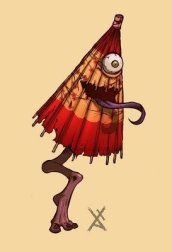
All Umbrellas Mean Bad Luck

kasaobake.jpg

Kasa-obake | Japan

“Animated umbrellas that jump around on one leg.”

Basic Facts:

  • Here we have another yōkai (like the ittan-momen and bake-kujira.) This can sometimes be thrown under the same name as the ittan-momen: a tsukumogami, but not all consider it to be that.
  • Other names include: karakasa-obake, kase-bake, and karakasa kozō.
  • If you couldn’t tell by the art above, the kasa-obake have a very distinct appearance. It’s usually an umbrella with one eye, hopping around on one leg. In some rare cases, they’ll have two legs but it’s highly unlikely to find. Every once in awhile, it’ll have two arms and sometimes be described to have a long tongue.
  • Initially, the kasa-obake was simply a humanoid spirit with an umbrella on its head…but as time went on the human became an umbrella. This is why people believe it to be a tsukumogami.
  • This is the most well-known yōkai (that is an object) and has been incorprated into card games, haunted houses, anime (Japanese animated shows), manga (Japanese comic books/graphic novels), and movies.

The Least Expected Myth

This week’s mythological monster is a day late but well worth it! This week’s highlight was one for the books and a new one even I hadn’t heard of.

Keep reading if you want to hear about a bolt of cotton that will smother you to death if given the chance.


ittan momen.jpg

Ittan-momenJapan

“Sentient roll of cotton that flies through the night and suffocates people.”

Basic Facts:

  • In Japanese mythology, the ittan-momen is a Yōkai, more specifically a Tsukumogami. A yōkai is a supernatural spirit in folklore while a tsukumogami is a tool that has been possessed by a supernatural spirit. Haunted items…spooooooky.
  • These spirits are more likely to be found in Kagoshima.
  • The type off cotton possessed is also what can be used to make clothes. Check your labels!
  • “Ittan-momen” literally translates to “one bolt of cotton” or “one tan of cotton.” It gives the idea of what the measurements are of the item (28.8 cm by 10 m).
  • Believe it or not…the ittan-momen has been adapted plenty in Japanese modern culture. Shows (anime, primarily) and monuments have been made in appreciation.

Foxy Lady

gumiho.png

Gumiho Korea

“Nine-tailed fox that freely transforms into a beguiling woman.”

Basic Facts:

  • How does the fox become the woman? It lives a thousand years.
  • The goal of the gumiho (also called Kumiho in Korea) is to seduce boys and lure them off to eat their organs. They focus on primary organs, such as the liver and heart.
  • Since the legend of the gumiho originated in China and also has a sister legend in Japan, the gumiho is differentiated by the item it carries. The gumiho keeps a marble of knowledge but it’s also used to help drain human energy. If a human steals the marble…they gain knowledge!
  • Even though they can turn into a woman, they maintain fox-like features.
  • Hoping for some good news? If the gumiho doesn’t kill or eat any humans…they’ll become human. Don’t forget…they’re spirits, not actual animals.

Nine Imps

dokkaebi.jpg

Dokkaebi Korea

“Impish spirits that transform from inanimate objects.”

Basic Facts:

  • Also called Korean goblins, they like to play tricks on humans (or help them – it can go either way.)
  • Physical descriptions of the dokkaebi can be found on ancient roof tiles but are usually frightening to look at.
  • Into wrestling? So are these spirits! in order to pass them, you should be able to wrestle your way out of their clutches of evil! Their weak spots include their right side and (some of them are one-legged) a simple push will get them down.
  • There are different types of dokkaebi. To be frank, there are nine common types.
  • Sometimes, rituals are hosted to get in the good graces of the dokkaebi but other times.

Overlapping Myths and Traditions

This is the first of our mythological creatures from East Asia and can we just say: we are so excited to share these!

For this week, we’re looking at the traditional Chinese dragon, also known as the East Asian Dragon. This creature is widely known within and beyond Asian history, used as symbols of great strength and honor. But let’s jump right in and see what we could possibly teach you!


chinese dragon.jpg

Chinese DragonChina

“Long, serpentine creature with elemental powers.”

Basic Facts:

  • Don’t be fooled! The serpent-like animal is the more commonly known dragons. They’re also described as turtles and fish.
  • The dragon usually has powers to control water, rainfall, typhoons, and floods (do you see the common trait of strength behind this all?)
  • Scholar Wang Fu of the Han dynasty recorded myths about long dragons having distinct features. It’s an interesting Google search!
  • Depictions of the East Asian dragon sometimes feature a flaming pearl. It’s symbolic of spiritual energy, wisdom, prosperity, power, immortality, thunder, or the moon.
  • Wings? Nope! East Asian dragons fly with the help of their mystical powers, nothing physical helps them soar through the sky.

Creature From The Black Lagoon…?

We’ve finally made it to the end of European legends and mythological creatures. Next week we’ll be venturing over to East Asia to see what sort of creatures and legends we can inspire you to incorporate into your writing!

Onto this week, though! Could we have found what inspired the Creature from the Black Lagoon?


vodnik.JPG

Vodník Czech Republic

Basic Facts:

  • The appearance of the Vodník varies…from a man with webbed hands and gills to a humanoid frog. The description of this creature depends on the location of the myth. His story gets around!
  • On the side of good or evil? The Vodník can be aligned with either. But the bad ones are the recorded ones. They try to drown people who are in their territory!
  • To pass the time, this creature likes to play cards, smoke pipes, or just hang out near the water and overlook their home.
  • Sometimes, fisherman give the spirit tobacco as a trade for fish.
  • They don’t have a mentioned home…but sea water is deadly for them! Just speculating, not confirmed.