Dancing Fireball

This week is our last week in Eastern Asia. Disregard the photo chosen for this week’s creature; there weren’t many options that really embodied what the creature is but there is very little to go on! You can be the judge.

Next week, we embark on mythological creatures deriving from Western Asia. Join us on our journey around the world!


Santelmo.jpg

Santelmo | Philippines

“Spiritual presence in the form of a dancing orb of flame.”

Basic Facts:

  • The name santelmo translates to ‘St. Elmo’s fire.’ It is also referred to as ‘Santo Elmo.’
  • Recently, the fires seen dancing along have been debunked by scientists…even though these fires have been reported since the Spanish era (that’s almost 500 years ago!)
  • Where did the name St. Elmo come from? To be clear, St. Elmo is the patron saint of sailors. Whenever the weather phenomenon (which is what scientists have deemed the fire) occurred, sailors saw it as a good sign. That’s a bit scary to be called a good thing, if you ask me.
  • If the santelmo was inspired by a weather phenomenon which occurs at sea, what does the creature look like? The best description is as follows (from Cryptid wikia!):

St. Elmo’s fires have ranged from a ghostly dancing flame to natural fireworks. It usually is of a blue of bluish-white colour attached to fixed, grounded conductors and has a lifetime of minutes. The flame is heatless and non-consuming occasionally accompanied by a hissing sound. These latter properties prove the myths of a spiritual presence.

  • The ball of fire spirit can come from the spirits of those who die in a river, the sea or while it’s raining. These versions of the santelmo are dangerous. They’ll drown someone!

A Brief Guide to Shaping the Next Generation

What lesson do you think kids (we’re talking teens, tweens, and drama machines) these days need subconsciously taught to them? Is it something you remember neglecting when you were a little one yourself and regret wholeheartedly? Or maybe it’s something you were never taught! Writing a YA novel can open a door in a young adult’s mind which will start them on the road to success or down a path of self discovery.

One thing to remember in writing a story for a younger audience is you want to tap into their emotions. This is a time in one’s life where they’re channeling all sorts of feelings: some old, some new. They’re trying to sort things out and maybe, just maybe, your book can assist them along the way.

You know what else teenagers are trying to sort through? The latest trends. You don’t have to be a genius to know this one. You were a teen once, right? Remember how you wanted to go and grab the most popular pair of shoes or learn every word to the number one hit on the radio so you could scream along with your friends and not feel like an outcast? Utilize teen culture to cultivate your world, your characters, and your readers. Don’t rely on trends too heavily though – it’ll make for a bad YA novel. Mainly because you’ll hear in the back of your head, “Mooooooooom!/Daaaaaad!” in a whiny tone to stop trying to be cool. You want to be able to speak to your audience, eye-to-eye, and connect with them.

Speaking of an audience, know who you’re targeting! You should that for any book before you start writing but it’s easy to write a book about young adults rather than for young adults – catch my drift? For example, Stephen King’s IT is about young adults, tweens, whatever…but it’s written for an adult audience. Don’t aim for adults: know how your audience talks (don’t go crazy with slang either, it’s not that important), what they like, what issues they may encounter. You want to be able to relate, not have your reader feel like you’re talking about them to another adult right in front of them.

problem.gif

Oh, and stereotypes. Tropes. Get rid of them. Or if you’re going to use them, please make the idea original. Please. The future leaders of the world are begging you to.

The Perfect Elephant

airavata.png

AiravataIndia

“A pristine, winged elephant that creates rain, steed to the God, Indra.”

Basic Facts:

  • Other names for Airavata are: abrha-matanga (“elephant of the clouds”), naga-malla (“the fighting elephant”), or Arkasodra (“brother of the sun”). The name, Airavata, loosely translates to “belonging to Iravati.”
  • This isn’t a normal elephant…it has ten tusks and five trunks. To top it off it’s white and spotless!
  • Last week, we talked about the churning of the ocean of milk, which created several treasures (or mythological creatures) alongside uchchaihshravas – one being Airavata. This is according to one legend – not the final answer!
  • The lovely Airavata is actually incorporated into a couple of flags like Laos and Thailand.
  • The Airavata is one of eight deities to look over the eight points of a compass. That’s quite the job!


Antagonizing Antagonists

Purpose. Almost every antagonist has a purpose.

purpose.gif

Are they trying the “take over the world” tactic? What got them to this point? Evil isn’t born from the black; it’s molded and crafted by life’s doing. If you’re writing a classic villain – give them the unique back story to give them epic purpose.

If your story is that of the everyday, then where is the bad guy? Are they standing right next to the main character? Are they in the cubicle next door? Are they after the same goal as the protagonist? The opposition is what gives the antagonist in this scenario purpose.

Here’s another one: your character is going against the government, or any large institution, “1984”-style. Why did this entity grow to be the way it is Why is the protagonist going against it? There shouldn’t be a “pure evil” motive because that means there’s someone behind the whole thing. It starts to blend in with other potential antagonist. Don’t confuse yourself! But there’s always…you guessed it…purpose behind the institution.

A new favorite and trend we see in writing is the internal antagonist. This mostly revolves around characteristics of the character and being held back by these traits. For the first time throughout this piece, purpose is stripped from the “antagonist” and comes to fruition out of some event or comes to light. These become more realistic because it may be an accurate portrayal of life itself.

So…take to the books and get writing your perfect, purposeful antagonist. Alright, we’re done using the ‘p’ word.

Seven Heads

uchchaihshravas.jpg

Uchchaihshravas India

“Seven-headed flying horse that became king of horses.”

Basic Facts:

  • The uchchaihshravas is the steed of the God King. But also the horse of the King of Demons.
  • The horse is described to be snow white, probably attributed to the creation of the horse. It came to life during the churning of the milk ocean, also called Samudra manthan.
  • Wonder what the name of the horse means? Long ears or neighing aloud. This is a pretty straight forward description of what horses embody.
  • Before becoming the King of horses, the uchchaihshravas was deemed the best of horses and a prototype by his master, Indra.
  • When born, there were other treasures who came from the churning of the milk ocean. The king of horses was not lonely!

Jumping Through Time

A story can include one of two things: flashbacks or skipping to the future. We don’t think recommending the two is a great idea but if executed cohesively…sure! Why not! Let’s discuss.

Sometimes, writing flashbacks can help a story flesh itself out. Readers understand the plot better, the character better, ANYTHING! But what happens when a flashback becomes more than a flash back? Meaning, what happens when a brief moment takes up a whole chapter? Is that acceptable? There isn’t any reason why it shouldn’t be acceptable – other than not being written properly. Make sure flashbacks are quick and easy. They’re meant to be memories triggered by people or items or occurrences surrounding the character or plot. Here’s an idea: it doesn’t necessarily have to be written in the perspective where the character is brought back to a moment in time…but rather, induces a feeling, an image flashed in the character’s thoughts. Something like that.

Skipping ahead in time is also a way to get the story moving along. Readers don’t need all filler details and a story doesn’t deserve that either! A few months can pass in the story in a matter of words, as long as the reader is caught up with the characters and ongoings in their world, what else is needed? Questions should never be left unanswered, too. If they are, there better be good reason for it. Did something happen prior to the time hop that wasn’t resolved during the time not mentioned? Well, it better come full circle because then the reader will not be happy (they’ll scream, “PLOT HOLE, PLOT HOLE!” and write a whole review about how the plot hole ruined the story for them.)

future.gif

So, now that we’ve lectured about time and the relationship it has with your story – let’s build a time machine and have some fun!

(Almost) Ending the Year On Some Trendy Business

We know, we know…it’s not our last post of the year, but it’s close to it! We figured it would be good for anyone looking into getting published to get the heads up: the results are in, publishing trends are here.

Before we get started though, we want to direct you to the source in which the general info comes from. Opinions and advice are ours! But check out this blog/publishing service.

Let’s get right into it!

going up.gif

  1. First and foremost, is the decline in reading going to push writers away from publishing their work?

    We vote a big fat NO. Reason being, we see the decline in reading as a way to push writers to treat their work with care (and to get into e-Pubbing, but we’ll discuss in a second.) Getting all the pre-publication shenanigans out of the way is something so many people don’t truly pay attention to – so maybe, it’s time we give our precious work some TLC and hire a few people to take a look at what we’ve got.

  2. Print books remain #1. What does this mean for you?

    While everyone (or maybe it was just me) believes that eBooks are the only way to read now, we come here to confirm: this is not true. Print books remain the champion of reading (even if less people do the act of reading.) Now, before you comment and say, “getting my book printed will cost so much money” or “I can’t seal the deal with PRH or Tor or any of those big publishers!” Don’t forget about print-on-demand: the most efficient way for a self-published author to get their book in physical format! So you can still make your way into the print market without a major publishing deal (sorry, big guys.)

  3. Audiobooks are still on the rise!

    We love audiobooks here at HRM. We talk about them enough to say we’re not surprised they’ll continue to rise come the new year.
  4. We’ve talked about it once, we’ll talk about it again: hybrid/collaborative publishing is important and will continue to rise in popularity in 2019. Why should it be important to you?

    Hybrid publishing and collaborative publishing are important mediums to self-published authors (or writers looking into self-publishing.) We want the quality of a major publisher (you know, the big tough editors and the fantastic printing jobs) but since deals from them are far and few between, we need an alternative. An alternative where we have creative flexibility and control over the work in question. These mediums are just that. They provide the quality care to your work as well as giving you the power over it – with consideration, of course. Major publishing houses ensure a bigger paycheck, but why not get your foot in the door to start?

  5. Marketing is your best friend.

    We talk about marketing a lot on this blog. It’s an important part of being a writer/author who wants exposure. If you’re interested in keeping up with a variety of marketing tactics, just use the search bar for this blog and we guarantee you’ll come across something.


Happy Holidays, everybody!

A Blob

Nuppeppo.jpg

Nuppeppō Japan

“Passive, genderless blob one can eat to gain eternal youth.”

Basic Facts:

  • This yōkai has a pungent body odor because it’s supposedly made up of corpses. I knew there was a catch…Makes it that much harder to eat.
  • While other spirits have some form of origin tale…the nuppeppō doesn’t. Even though it’s been around since the 18th century.
  • You’ll most likely find this blob in deserted streets, abandoned temples, and…you guessed it…graveyards.
  • They are entirely harmless!
  • Although the blob is just that…a blob…the nuppeppō has folds all over it. Which makes it look like it has eyes, a nose, a mouth, arms and legs.

Simplicity & Books

Keeping up with book trends and sales? Don’t worry. We are too. There will always be highs and lows, one extreme to another. This isn’t really a trend but just a little something we noticed in the office. Everything is so simple.

so simple.gif

Sure, writing the book isn’t simple…getting the book to be noticed by an editor/publisher isn’t simple…the process of production isn’t simple…but when the final product of the book is in the author’s hands or a trusty reader’s yearning finger tips…do they just look at the cover and think, it’s so simple? We’re referring to the cover art itself. And because we came across a list of books in which the title said, “Most Beautiful…”, we thought it was about time we sit down and chat about cover art. Again.

Calling something beautiful is subjective to the writer of the article. Some of the titles on this list have been hyped up and plastered all over the internet, they were bound to become bestsellers. But there was one common thing among the covers we needed to stress. They’re so simple. There’s nothing wrong with simplicity but the simplicity of these books has helped bump up sales revenue. Many fiction titles are beginning to look…uniform. Once again…there’s nothing wrong with it. It’s getting money in someone’s pocket, regardless.

We’re not here to dictate what you should do with your book. But if you find yourself in need of change and you could envision a bit of abstract art or an object as the cover of your book, then maybe it’s time you send out a few emails to the cover designers out in the world. You may appeal to a new crowd looking for the simple covers that get them wondering what the heck the cover is trying to tell them.

Thank goodness we live in a digital age where all we have to do is delete and upload a new image.

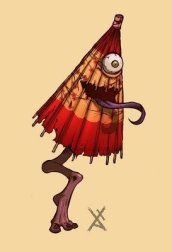
All Umbrellas Mean Bad Luck

kasaobake.jpg

Kasa-obake | Japan

“Animated umbrellas that jump around on one leg.”

Basic Facts:

  • Here we have another yōkai (like the ittan-momen and bake-kujira.) This can sometimes be thrown under the same name as the ittan-momen: a tsukumogami, but not all consider it to be that.
  • Other names include: karakasa-obake, kase-bake, and karakasa kozō.
  • If you couldn’t tell by the art above, the kasa-obake have a very distinct appearance. It’s usually an umbrella with one eye, hopping around on one leg. In some rare cases, they’ll have two legs but it’s highly unlikely to find. Every once in awhile, it’ll have two arms and sometimes be described to have a long tongue.
  • Initially, the kasa-obake was simply a humanoid spirit with an umbrella on its head…but as time went on the human became an umbrella. This is why people believe it to be a tsukumogami.
  • This is the most well-known yōkai (that is an object) and has been incorprated into card games, haunted houses, anime (Japanese animated shows), manga (Japanese comic books/graphic novels), and movies.