On Location

It’s not in everyone’s best interest to sit in their home office to write. Works for some, not for the rest. A few may take a ride in their car to a local place they find inspirational. Others take a hit to the wallet and hop on a place to their most relaxing destination. The purpose isn’t to escape the process of writing, but lay the seed of inspiration and nourish it with the surrounding scenery.

Is anyone a location-inspired writer? If so, where do you like to write?

Coffee shops?

The beach in a comfy chair with your toes in the sand?

In a hotel with a magical view of snow-capped mountains?

Local park?

travel.gif

The Jungle Dwarf

curupira.png

Curupira Brazil

Jungle genie with bright red hair and backwards feet.

  • Curupira is a blend of West African and European fairies, and was once considered a demon.
  • The name comes from the Tupi language, which translates to covered in blisters.
  • You’ll be able to spot this creature from a mile away. He has bright red/orange hair, usually resembles a man or dwarf, and has feet turned backward.
  • How can this little guy be threatening? He creates illusions and produces sounds to drive their victim to go crazy.
  • Don’t worry…they only go after poachers and hunters; those who take from the jungle they live in.

Mother of the Mountain

madremonte.jpg

Madremonte Columbia

Forest mother that protects flora and fauna from mankind.

  • The mother of the mountain has been described as an elegant woman who wears moss and leaves with a green hat to conceal her face.
  • You’ll find her living in the jungle and whenever she bathes in a river, her presence will cause flooding and heavy storms.
  • Her motive lies within protection. She will haunt those who steal land and casts plagues on those who fall under that realm.
  • She also dislikes unfaithful spouses, vagabonds, and other types of problem makers. When these people walk through her forest, they’ll encounter numerous obstacles to wear them down and force them to sleep for many hours on end.
  • She’s also compared to that of Mother Nature.

La Chupacabra

chupacabra.jpg

Chupacabra Puerto Rico

Bear-sized, spiky creature that drinks livestock blood.

  • Breaking down the word, chupacabra can be translated to “goat-sucker” (chupar means ‘to suck’ while cabra means ‘goat’.)
  • It’s primarily found in Puerto Rico but it’s been reportedly seen as far north as Maine, and as far south as Chile. Occasionally, you’ll hear of the creature popping up in Europe.
  • The chupacabra’s first reported attack happened in 1995. This myth is still very young!
  • Appearance varies on the place; it can be the size of a small bear, can have scales (making it more reptilian), a sharp spine, or may have quills. But guess what? It’s only supposedly 3 feet tall (can be up to four feet) and hops like a kangaroo. It’s sometimes described like a dog.
  • They’re motive is similar to a vampire; their victims are always found drained of blood – not slaughtered.

Canada’s Loch Ness Monster

ogopogo.jpg

Ogopogo British Columbia

Lake-dwelling serpentine monster.

  • Sightings started in the 19th century but have been discredited to being a legendary water spirit, living in Lake Okanagan.
  • Other than having the body of a snake, the head has been described to be that of a snake, horse, or even a goat. Sometimes it has long ears or horns with blue or brown scales.
  • It eats flesh. That means humans…turn into prey. Hunters become the hunted. Native Americans never traveled across the lake without sacrificial meals on board. Now, its believed the monster dwells in one of the corners of the lake.
  • It’s very similar to the Loch Ness monster of Scotland.
  • The ogopogo is sometimes thought to be an extinct whale or marine reptile.

The Cannibal Monster

This is one of the last two areas of the world we are traveling too. So, let’s venture into the deep woods of the Americas to start the beginning of the final countdown!


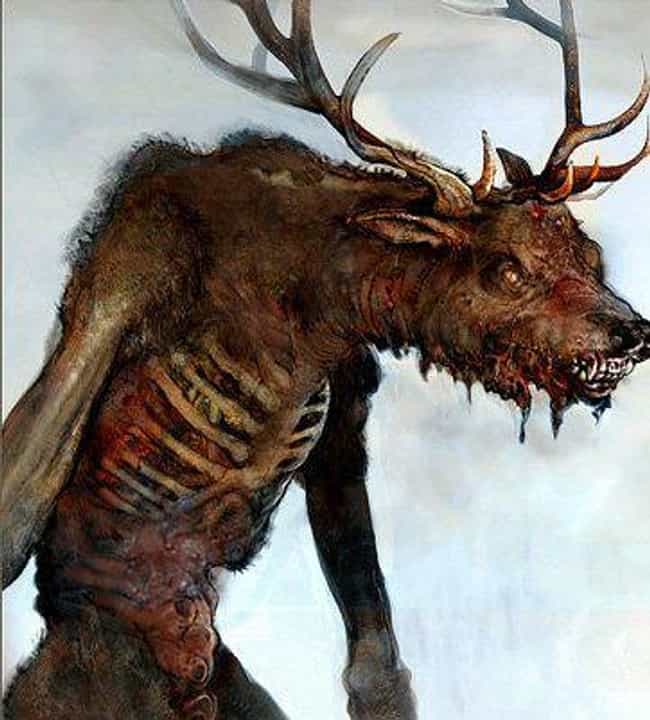
Image result for wendigo

WendigoAlgonquian Tribes

Cannibalistic beastly humanoid, possibly once human.

  • This creature is aligned with murder, insatiable, and cultural taboos against “normal” behavior. They’re also associated with the winter, the north, coldness, famine, and starvation.
  • The Wendigo is bigger than a human, and whenever it feeds on human flesh, it grows! It never gains weight and will always appear thin. They’re always hungry so watch out!!
  • There’s also an explanation as to why they may have been human once before turning into the Wendigo. When they were human, they may have been incredibly greedy. Or if the human was in contact with Wendigos for too long, they would become one.
  • Powers include: mimicking human voices, possession, controlling weather, manipulation of darkness (sunset), control of forest creatures, healing, and incredible strength and speed.
  • Believe it or not, there is a psychological disorder called the Wendigo Psychosis. People diagnosed crave human flesh even though they have access to normal food sources.

Downsizing Your Writing

Inspired solely on the act of decluttering a home, we’re talking about a part of editing some people dread: downsizing the finished product.
hoarding.gif

There is a such thing as writing too much. Spending an excessive amount of your time world-building all at once, having long conversations between characters to reveal information, or describing your characters in great physical detail and not focusing on the plot. These are examples! There can be all kinds of details you may be able to omit!

If you find yourself growing insecure or anxious about your ability to write effectively for an audience, you may want to begin the downsizing process.

Those moments too large (or too long)…revisit them. Break it down and see what can be taken out. What’s important to your writing is showing your reader what’s going on around your character or how your character(s) perceive the world – not telling your reader. They won’t feel it.

Small details may be important to hold onto so save them in a note on the side. They might be able to be woven into the narrative in a flowing manner.

Try to set a time frame in which you’ll work on this form of editing. And if you have to – do it more than once. You’ll realize how a whole paragraph may only needed to be one sentence.

Revenge of the Scorpion Man

This creature was a feature in the Mummy series. Definitely something worth getting the chills over! 😱


aqrabuamelu.png

Aqrabuamelu Former Mesopotamia

Warrior with a scorpion body and male torso.

  • These creatures (made both male and female but more known as male) were created to wage war against younger gods by an older goddess.
  • They were also known to stand guard to gates leading to other gods (the list of gods differ).
  • The Aqrabuamelu doesn’t have magical powers, at least not ones officially documented – only speculated. With purely physical abilities, they utilize their human body and scorpion body in their own ways.
  • Wonder if they were the size of scorpions? Nope! Supposedly, their heads touch the sky.
  • Along with their fearsome tail filled with poison, they’re actually skilled with a bow and arrow.

Earth Fish

Bahamut.png

BahamutMiddle East

Colossal fish that is one of seven layers supporting the Earth.

  • Bahamut is sometimes considered a nickname. Balhut is the earliest name for the fish. Bahamut came along and is actually translated from the word, “behemoth.” (And other references but crazy!)
  • You can’t see Bahamut but he keeps us out of the black abyss, while swimming around in the underworld.
  • The general consensus on what Bahamut looks like revolves around a huge animal. Some stories give him different appearances but the more notable figure is the water-dwelling animal.
  • Can a fish even have powers? With his size, you think that would be it. Lo and behold, in other mythological tales, Bahamut has the ability to drive someone mad if seen (which is most unlikely, but whatever.) Another version of Bahamut can control all wild predators on Earth with a simple roar, during the summer solstice. This power keeps the animals tamed until the next year.
  • Weakness isn’t a word Bahamut knows…but obedience is. If he doesn’t obey his Creator…he could get killed!

Proof It Once, Proof It Twice…

…Third times a charm! Right? Right?

Unfortunately, that’s not the case when it comes to editing and proofreading your novel. If you’re trying to save money and doing everything by yourself is your only option, we want to be there for you.

Meaning, we’re going to give you some advice.


editing.gif

  1. Take some time away. We mean it. You may not be able to do a vacation getaway from your writing, but you could leave the room. That’s like a vacation, right? Leave your writing domain for an extended period of time and take a breather. You deserve it! And plus…if you jump into proofing and editing immediately, you’ll end up critiquing yourself as a writer more so than edit your actual book.
  2. Figure out what you want the process to be likeWhile you’re away from your writing space would be the best time to do this! Mapping out your editing goals will help you focus on what’s important and needs to be done. Don’t let your mind wander!
  3. Sit down.
  4. Make sure you’re reading your book as a strangerAnother important part of taking a break is coming back with a new, fresh perspective. With healthy distractions, you’ll be able to forget (for the most part) what your book was like and when you start to re-read, you’ll think…”What did the author say?…Oh wait, that’s me.” You’ll notice details differently, too.
  5. Get into the reading groove. Maybe you’ll read very slowly, maybe you’ll read it aloud to yourself (or force someone to read it for you…ALEXA.)
  6. Pace in your space because it becomes too much.
  7. Don’t worry! We always see writers attempting to word particular things differently. Don’t worry about that. Sometimes…you just have to use the word ‘said.’ There’s no reason to get fancy. Focus on other bits, not that.