Not Your Average Bee Hive

nest of bees.jpg

Nest Of Bees

  • This was a rocket battery used by the early Chinese Ming Warrior, warriors in existence during the Ming Dynasty (1368).
  • It’s a long range weapon. It cast 32 arrows in one shot, which were tipped with rockets. The arrow tips themselves were tipped in poison or something flammable – to increase enemy kills. They traveled up to 5 football fields away.
  • The nest itself was a hexagonal tube, equipped with a shoulder strap so warriors wore them like backpacks. It protected them from flying debris.
  • If this weapon sounds familiar, that’s because as time continued on…the nest of bees evolved into rockets/missiles of our modern era – which continue to evolve as we speak.

Breaking Down Sci-Fi

Note: Although we are focusing primarily on the genre of science fiction, most, if not all, points mentioned in this post can be applied to other genres in writing!


  • Star Wars
  • Star Trek
  • Octavia Butler
  • George Orwell

These are only a few names known in the realm of science fiction (sci-fi from here on out.) Our own worlds have broadened because someone took the time to travel to the futuristic unknown rather than entering a fantasy world. But what are some key components to writing sci-fi? Let’s get talking!

star wars.gif

Like any other creative writing project, planning and mapping out your story is crucial and necessarily before you dive into your tale. Not only for plot purposes but you always need to question: “how will this affect that?” You know, the usual. Depending on your sci-fi story, you’ll get the opportunity to create even further. For example, settings are new, language is different than what we know on our planet, races vary even more so than skin color…there are so many details to account for! We always recommend doing research into other novels within your genre range. Take it a step further and watch shows and movies. It’ll help further stimulate your creativity.

Something to help you indulge in your research is looking into scientific journals, new discoveries by labs or space teams, etc. This can influence your story in any way you want it to. Shaping your universe with new discoveries and current-world situations. Not only that but you’re expanding your own knowledge. what a way to kill two birds with one stone!

Our last point we’d like to highlight pertains to another question you can ask yourself. What if…? Utilizing the knowledge in the journals you find and articles you read, you can mix this with the creative details you’ve mapped out thus far. Apply your ‘what if’ question and add more depth to your story, add a new element, or a new plot line. Whatever the case may be, you’re adding something to the story by asking what if.

So what if…you start writing now?

Language 101

We can all agree: languages are fun to write, sometimes. Other times, they’re difficult to work with. There are a variety of languages, accents, dialects, and so on we have to keep track of while writing our dialogue. There is a way to write them effectively, so let’s talk about it!

The readers of this day and age don’t typically take a liking to phonetic spelling. It may not be the route to take if you want to build an audience. These readers may not want the challenge in reading non-standard English. The real downfall is how much time they’re going to spend deciphering what the characters are trying to say without diving into the deeper meaning.

Any language can relate…no one speaks their language the same way. This is where dialect plays a huge role into how language is spoken and can be portrayed in writing. When anyone learns a language in grade school, they aren’t learning the different dialects of the language…but one can learn through native speakers in certain areas. Depending on region and ethnicity, everyone speaks differently. Utilizing modern language with minor change to the dialect and phonetic spelling here and there will improve the quality of your story. This is only important if communication between your characters is a central point in your story. Most characters interact with others – but sometimes the language in which they speak…speaks volumes for the story.

speaking french.gif

Some important bits to remember when writing in other languages or dialects are diction, syntax, and idioms. All of these key components help the conversations between your characters become unique to them. Even if things sound strange to you, it may be best to detach your experiences from that of your characters speech.

Always remember: you want your characters to come off as unique through dialogue, especially if you want your reader to be able to distinguish who’s speaking. We also want less boring and more relatable characters so you have to find the perfect balance!

Last, But Not Least

We’ve loved sharing these mythological creatures and the outline of their legends/stories. We hope you’ve been just as inspired as us to create your own legend – inspired by these creatures or recreating their legend in your own retelling. In a way, we’ve traveled around the world and have explored so many countries and their legends.

If you have any other creatures we missed and you want to share, comment down below and let us know what your favorite myth is!


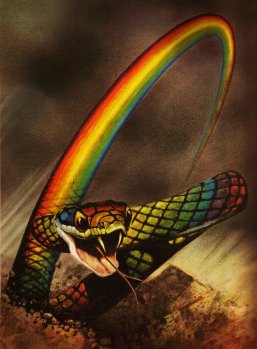
rainbow serpent.jpg

Rainbow SerpentAustralia

Rainbow snake that represents the cycle of the seasons.

  • A creator god who is a common motif in Aboriginal Australia, one of the groups of indigenous peoples of Australia.
  • The representation of the rainbow and the serpents are that of human life and need for water.
  • Although the god is angelic in a way, they can easily turn into a destructive force.
  • Most legends describe the serpent as being male but others have labeled it as female or androgynous and bisexual. It has a link to fertility and its association to gender and sexuality show that!
  • This godly snake is worshiped through rituals, usually in relation to female menstruation.

Australia’s Monsoon Deliverer

wondjina.jpg

Wondjina Australia

Cloud and rain spirits that deliver monsoons.

  • These spirits created the landscape and humans living on it. Talk about a God.
  • They painted their image on cave walls and entered a waterhole once they’ve found a place to die.
  • While the appearance of the Wondjina spirits vary, due to how they’ve painted themselves, they are more commonly known to have large upper bodies and heads. They have eyes and a nose…but no mouth.
  • A missing mouth is sometimes attributed to the fact of how powerful they may be. If they spoke, rain would never stop!
  • Their control of the weather only occurs when someone breaks the law. They’ll bring floods, lightning, and cyclone.

Water Dog

This is the last creature of the Americas we are going to dive into. After this one, we will only have four mythological creatures left, all located in Oceania! Gah! Feels like just yesterday we were diving into the world of mythology.

What should we cover next?!


ahuizoti.jpg

Ahuizoti | Mexico

Aquatic canine creature with a tail-hand.

  • The fur on this hound clumps together to create spikes. Its hands are capable of manipulation, similar to humanoids.
  • It likes humans, particularly nails, eyes and teeth. Shield yourself!
  • You’ll find this creature near water. Any bodies of water. Caves near water. All of the above. As long as it’s near water.
  • If prey is spotted, it’ll use its unique tail to swipe them up and drown them.
  • Whoever is taken, their sacrificed to the rain god, supposedly.

On Location

It’s not in everyone’s best interest to sit in their home office to write. Works for some, not for the rest. A few may take a ride in their car to a local place they find inspirational. Others take a hit to the wallet and hop on a place to their most relaxing destination. The purpose isn’t to escape the process of writing, but lay the seed of inspiration and nourish it with the surrounding scenery.

Is anyone a location-inspired writer? If so, where do you like to write?

Coffee shops?

The beach in a comfy chair with your toes in the sand?

In a hotel with a magical view of snow-capped mountains?

Local park?

travel.gif

The Jungle Dwarf

curupira.png

Curupira Brazil

Jungle genie with bright red hair and backwards feet.

  • Curupira is a blend of West African and European fairies, and was once considered a demon.
  • The name comes from the Tupi language, which translates to covered in blisters.
  • You’ll be able to spot this creature from a mile away. He has bright red/orange hair, usually resembles a man or dwarf, and has feet turned backward.
  • How can this little guy be threatening? He creates illusions and produces sounds to drive their victim to go crazy.
  • Don’t worry…they only go after poachers and hunters; those who take from the jungle they live in.

Mother of the Mountain

madremonte.jpg

Madremonte Columbia

Forest mother that protects flora and fauna from mankind.

  • The mother of the mountain has been described as an elegant woman who wears moss and leaves with a green hat to conceal her face.
  • You’ll find her living in the jungle and whenever she bathes in a river, her presence will cause flooding and heavy storms.
  • Her motive lies within protection. She will haunt those who steal land and casts plagues on those who fall under that realm.
  • She also dislikes unfaithful spouses, vagabonds, and other types of problem makers. When these people walk through her forest, they’ll encounter numerous obstacles to wear them down and force them to sleep for many hours on end.
  • She’s also compared to that of Mother Nature.

La Chupacabra

chupacabra.jpg

Chupacabra Puerto Rico

Bear-sized, spiky creature that drinks livestock blood.

  • Breaking down the word, chupacabra can be translated to “goat-sucker” (chupar means ‘to suck’ while cabra means ‘goat’.)
  • It’s primarily found in Puerto Rico but it’s been reportedly seen as far north as Maine, and as far south as Chile. Occasionally, you’ll hear of the creature popping up in Europe.
  • The chupacabra’s first reported attack happened in 1995. This myth is still very young!
  • Appearance varies on the place; it can be the size of a small bear, can have scales (making it more reptilian), a sharp spine, or may have quills. But guess what? It’s only supposedly 3 feet tall (can be up to four feet) and hops like a kangaroo. It’s sometimes described like a dog.
  • They’re motive is similar to a vampire; their victims are always found drained of blood – not slaughtered.