
author
Creating Your 2016 Action Plan
The new year always brings lots of talk about goals. We often get so wrapped up in where we want to go this year that we forget that we need an action plan in order to get there. It’s great that you want your book to land on the New York Times bestseller list, but how are you going to get it there? It’s most likely not going to appear there by itself. That would just be too easy. Once you have your goals lined up, next step is to create a plan. Formulate tools that are going to help you reach those goals. A good action plan turns goals into reality.

This afternoon I came across an article on Poynter that handed out some pretty refreshing suggestions for productive writing. Sometimes the action plan seems so overwhelming that we quickly start to doubt that we will even make it past step two. That’s why I loved this article so much, it makes productivity sound easy. The article provides five doable solutions to having a productive writing year. It’s something we can all do without too much hassle. It makes our goals seem within our reach, which is half the battle. We need to believe in ourselves before others will. While creating your 2016 action plan, try incorporating some of these tools:
- Create a to-morrow list.
Slim down your “to-do” list every night. Make a smaller list of 3-5 things that you know you will be able to accomplish tomorrow. Often there are many pending jobs left on our ever expanding “to-do” lists that we constantly have the nagging feeling that we are doing so much but we aren’t moving anywhere. Feel your progress with shorter lists meant for success. Tomorrow never felt so good.
2. Dream Big.
This one might just be my favorite. 2016 is the year of big changes. Big changes means big goals. Take a moment to picture your wildest dream ever. Don’t be afraid to get a little crazy with it. Draw a quick picture of your ultimate success and hang it in your work space. Yes, I said it- draw. It doesn’t need to be the next Picasso, but visual reminders are often the most effective. A take a look at that drawing every day before you get to work. Use that energy to make your day the most productive it can be.
3. Build your own ladder.
Create your action plan in chronological order. Start from the bottom and work your way up. What needs to happen before you can take the next step? Don’t get ahead of yourself. Live within the moment and savor every step of the journey.
4. Just do it.
We can only plan so much before we want to rip our hair out. Sometimes we just need to sit down and write. Get all your thoughts out of paper then go back and revise, polish, revise, polish. In order to create something, you need to have a product. Get your baseline product done early so you have the most amount of time possible to make it the best version of your product out there.
5. Set a timer.
It’s really easy to feel overwhelmed when writing, especially when nothing seems to be working out the way we had envisioned. Work in smaller spurts. Set a timer between 30 minutes to a couple hours. Work until the buzzer goes off, then take a break. If you are really feeling what you are writing, keep going. If not, it’s the perfect opportunity to hit the reset button.
Happy writing! Write On.
New Year, New Writing
I hope everyone had a fabulous holiday season and a very happy new year! I cannot believe it’s already 2016, where does the time go (like, for real)? The start of each year gives everyone the perfect opportunity to take a moment out of their busy schedules to reflect on what has happened over the past year, what they accomplished, what they didn’t get to do, and what they want to change for the coming year. This is a really great time for writers to sit down and think about where they want to go with their work. Are you happy with your current success? Do you need to make any major changes to make yourself more successful? Is there something new you have always been dying to try? Do you want to write more or less? Do you want to try your hand at shorter or longer works? The new year isn’t just the perfect time to reinvent yourself, it’s also the perfect time to reinvent your writing.

If you are looking for a little new year inspiration, I came across a fun article on Business 2 Community this afternoon that gives some ideas for writer’s new year resolutions. Hopefully these suggestions will help inspire you to make your own changes. Change is the only way to continually see the results we want. If we become stagnant and comfortable, soon enough our ‘luck’ will run out.
- Write that ‘thing’ you have always been talking about.
The best new year’s resolution for a writer is to stop talking and start writing. We all have that something that we have always talked about writing, but for whatever reason we haven’t picked up the pen yet. We may have even written countless other stories in the meantime, but that one project just can’t seem to make it’s way to fruitation. Think about what’s holding you back and throw that negativity out the window. 2016 is all about action and change, make it happen so you can move onto the next thing on that growing bucket list of yours.
2. Visit the places you write about or want to write about.
The best way to effectively write a scene, chapter, or story is to write from experience. Plan a couple vacations or day trips this year to visit those places you write about. Spend some time writing in those places as well. Visual inspiration is often just the thing we need to bring our writing to life.
3. Read a book that has had a big impact.
Pick up a book that has made a difference. Read a book that has changed history, that has left many readers talking years after it’s publication. Think about why this particular book was so successful. Become part of it’s history and use it to create your own.
4. Learn a foreign language.
This one is certainly a daring and daunting task, but one that could change the course of your writing forever. Learning how other languages construct sentences, how they use different words, and how they express emotions can open up countless new avenues for your own writing. You don’t need to become fluent is the language, just familiarizing yourself about a particular language’s ‘rules’ will teach you a lot in itself.
5. Study your own writing.
Look back at what you have written over the past year and learn from it. Is there a particular mistake you catch yourself making over and over again? Are there certain words you use too much? Do you find all your characters to be eerily similar? Make note of the things that have worked well too. Your biggest teacher is often yourself.
Here’s to another great [writing] year! Write on.
The[Writer’s] Block-Buster


Becoming Your Own Editor
I do a lot of posts about editing on this blog, it’s no secret. To be honest, I have been feeling kind of lost lately because I haven’t done one in a while. There must be something real off in the universe, right? But have no fear, Bustle answered my cry for help this morning. Rachel Krantz reads essay submissions for Bustle and also conducts monthly writing seminars/workshops for their writers and freelancers alike. It is very safe to say that she has completely immersed herself in every part of the writing process, for better or worse. Her last seminar focused on self-editing (insert happy dance here). It is actually one of the more helpful articles I have stumbled upon when it comes to editing, giving me even more of a reason to share it with you.
I don’t want this advice to replace hiring a professional editor. If you have room in your budget to hire professional help, I would still highly recommend it. I’m also in touch with reality enough to know this isn’t possible for everyone, making self-editing one of your prime concerns because you simply don’t have a choice. Whether you are writing a news article, an essay, a short story, or a novel editing can seriously make or break you. You can have an awesome story, but if the reader/editor evaluating your writing can’t get through a few pages (or lines) without finding structural or grammatical errors your writing is automatically going in the ‘trash’ pile. It may not seem fair, but it’s really hard for someone to connect with your writing when all they can think about are the mistakes that keep popping up. Despite if they are easy fixes or not, most editors aren’t going to be willing to work with you if they can’t connect with your story.

Below you will find some advice from Rachel’s seminar, but you should really check it out for yourself too:
- Get your FAME on.
Rachel created an acronym for the process of self-editing before you even start writing, she calls it FAME.
–Free Write: Designate a certain amount of time and just sit down and basically barf up your story in any way, shape, or form possible. Just write whatever comes to mind. Don’t stop and most importantly, don’t think. Just write.
–Account For Your Details: Look for patterns. Words that repeat themselves and themes that keep reoccurring. Highlight those details.
–Map Your Arc: Create a general map of your story. It will be helpful to know where you are starting, what your climax is going to be, and where you will end up.
–Expect An Audience: Figure out who your audience is before you start writing. Also, make an ideal word count. Different forms of writing, different age groups, and different genres all have different ‘ideal’ word counts. It’s best to figure that out before you start writing.
2. Embrace the first edit with questions.
How nice would it be to only have to do one edit and then call it a day? That has to be every writer’s dream, right? Unfortunately, your first edit is going to be one of oh, I don’t know… 100? It might be helpful to approach your first edit with some questions in mind, instead of focusing on just finding the mistakes. I bet there are many areas that could still be developed, cut down, or made clearer. Your first edit is the best place to tackle these problems. That’s why Rachel provides key questions on content, form, and length for you to think about. It’s important to get these issues resolved as early as possible.
3. Walk away.
Once you complete your first edit, walk away from your writing for a few days. Work on something else, treat yourself to a reward, or pick up that book you have been dying to read. Give yourself some time to digest all the work you have done so you will be able to come back to it with a clear mind.
4. Conquer the second edit and so on.
During your second edit, make sure to revisit the same questions you asked yourself during you first edit. Make sure you still feel the same way about them. Rachel also poses some new questions for you to think about to make sure you are still following your original intended track.
5. Recruit a friend.
Ask a friend to read it through. A fresh set of eyes can often save your writing. Sometimes we become blind to the one thing that really needs our attention because we are so busy making sure our overall message is delivered. You might even want to give them the questions that Rachel suggests, so they can think about them while reading.
Self-editing is scary, let’s just admit it. But, with a little help from people who have been there we will be able to get through it, hopefully with the same amount of hair on our head as when we started. Write on.
Make Criticism Feel Good
One of the hardest parts of writing is the criticism that naturally comes along with it. Perhaps this even holds some of us back a bit. Writing makes you vulnerable. The whole point of writing is to pour your heart out onto the page (for days, months, or even years), put it out there for the world to see, and then wait for the reaction. We all hope for stellar reviews across the board and thousands of copies to be sold. But the reality is that no matter how perfect your writing is, there is always going to be someone who just doesn’t like it. It’s very hard to please everyone and that is one of the first things you need to accept if you are going to have a fulfilling and successful writing career. But, it’s not easy. Those comments hurt and often stick with us for years to come, popping into our mind most often at the worst possible time. Writing isn’t just about becoming a better writer, it’s also about becoming a better version of yourself. Writing teaches us many things and how to handle failure and negative criticism with class is just one of them.
I was so happy to see an article about criticism on Elite Daily yesterday- especially at this time year. Things are starting to wind down and we are starting to look into next year. We start setting our goals for the upcoming months, goals that most likely include more risk being taken and pushing yourself farther than you ever done before. With bigger risks often comes bigger criticism. But don’t worry, it’s not all bad. These pieces of criticism will most likely yield your greatest lessons. Here’s a few things that Merylee Sevilla has learned about enduring criticism.
- Critics will always exist.
There is always going to be someone out there that has something negative, no matter how big or small, to say about your work. The most important thing to remember is that they are criticizing you based on their own opinion. There are still many other people out there who absolutely love what you are doing- focus on that.
2. Grow tough skin.
Don’t let other people’s negativity get to you. Instead of feeling down or discouraged, use their criticism as energy. Energy to become a better writer and to perhaps win them over the next time around. Turn negativity into positivity.

3. Learn how to become innovative.
There’s a lot of criticism out there about not being ‘original’ enough. It’s really hard to be original. With the ease of the internet, more stories are getting published each day than ever before. Take your focus from trying to be ‘original’ and start being ‘innovative.’ Put new spins on stories that have already been done, break the rules a little, and aim to surprise your readers. Innovation is a much more realistic and just as effective goal.
4. Just go for it.
Your biggest regret will be holding back. If you are afraid to publish a story because of the possible criticism that might come along with it, you are missing a huge opportunity. A negative comment might hurt for a few days but the pain of a missed opportunity will never go away. Be brave, be bold, and publish your work as you imagine it to be.
Write on.
The [Writer’s] Block-Buster


Writing Your Own Story
Memoir writing is a popular form of expression. Many of us experience at least one life changing moment in our lives and it’s natural to want to share our experiences. It’s in our human nature to want to help others who may be going through the same thing we did or to connect with people who have had similar experiences. We hate to feel alone and reaching out to others who know what we went through or are currently going through is comforting. Writing and putting our experiences out there is the easiest way to build your own personal support group. Writing is also therapeutic, allowing you to work through your feelings and maybe even find some feelings you never knew were there.

Author Mary Karr recently published a book entitled, The Art of Memoir. She presented her book to a group of fans in California and gave out some really priceless advice for all of those struggling to write their life story- whether you wish to publish your writing or just keep it for yourself.
- You need to discover yourself before you can accurately write about yourself.
Before you sit down to write that memoir that has been stuck in the back of your mind for years, make sure you truly understand yourself. It sounds kind of silly, but you need to know who you are first- your beliefs, values, likes, dislikes, etc. You don’t want to accused of writing a ‘fake’ memoir. If you don’t truly understand who you are, how are other people going to? One exercise that will help with your soul searching is writing out a list of all the significant moments in your life. Sit down and think about your life from the moment you were put on this Earth. What stands out to you? What memories keep coming back to you? Those are probably the ones worth writing about.
2. Find your theme.
As you start to write, your memories will naturally start to group into themes. It’s then that you will truly find out what’s important to you.
3. Reaching ‘the end’ is a long journey.
Writing about yourself will be an emotional roller coaster, to say the least. There will be a constant fight between who you are versus who you think people want you to be. Don’t give into the critics or haters. There’s always someone that’s going to want to tear you down, especially when you are vulnerable. Don’t be afraid to acknowledge the criticism and even criticize your own work. The more layers you uncover, the more real your memoir will become.
I particularly like the advice about only sharing your memoir writing with close mentors or writing groups for a long time. Before you show it to your family and friends, you need to have processed it yourself. You need to be happy with the product and confident in the words you put down on the page. Revealing your writing to close family and friends might lead to some uneasy emotions or some hurtful comments. People can become defensive easily, especially if they are mentioned in your writing. You need to be ready to give your family and friends time to process your writing just as you had to do yourself.
Remember that the most important thing to do when writing a memoir is to write your own story. Write On.
Can You Write Too Much?
Over the weekend, I came across an article by Stephen King on The New York Times website. King talked about whether or not a writer can be too prolific. I found this to be an interesting topic and one I continually found myself thinking about. It never occurred to me that there may be such a thing as too much writing. To me, if you have the ideas, time, and ability you should be writing. A lot of writing in turn produces a lot of books- what’s wrong with that? I know literary critics are often harsh on authors who produce a lot of product. They often aren’t taken seriously in the “intellectual” literary world because how could someone produce high quality, perfect work in just a few months? Quantity has a history of automatically devaluing your work when it comes to critics and publishing professionals. Our world is constantly evolving and it’s about time that way of thinking changes along with it.
King highlighted a couple of very interesting points in his article. My favorite line from the article is, “No one in his or her right mind would argue that quantity guarantees quality, but to suggest that quantity never produces quality strikes me as snobbish, inane and demonstrably untrue.” It irks me that an author could be passed over solely due to the number of books he/she has to their name. Assumptions should not be made before the research is completed. Looking at King’s book rooster of over 55 books, it wouldn’t be uncommon for one to think that he is just turning out junk after junk just to get books published. But, what about actually picking up one of his books? If you do, you will find that the quality, despite the quantity, is certainly not lacking. King, along with the many other authors he mentioned in his article, deserve just as much high literary praise as anyone else. Quantity does not equate to quality, no matter which way you look at it.
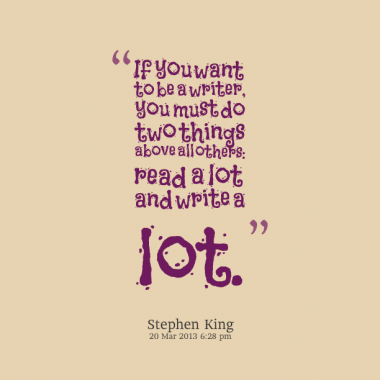
I also found much meaning in King’s reasoning to be prolific, “But I also understand that life is short, and that in the end, none of us is prolific. The creative spark dims, and then death puts it out.” Our lives are not prolific, death is the end game for us all. With our death, our ability to write and create dies as well. As writers, our worst fear is to die before we had a chance to say everything we wanted. Why not take full advantage of our gift while we have it? We need to make the most out of the life we are living, while we are living it. If you want to write 60 books, write 61.
As King concludes, prolificacy is not a bad thing if it’s used correctly. We want our work to be polished, thought out, and valuable. For some, that takes years. For others, it could only take weeks. We all work at our own speeds. We all have our own processes.It doesn’t mean one end product is any better than the next. Don’t ever shy away from writing because you are afraid of producing too much. Let the critics do their job (and ignore them if you have to) and you do yours- write. Write on.
The [Writer’s] Block-Buster


